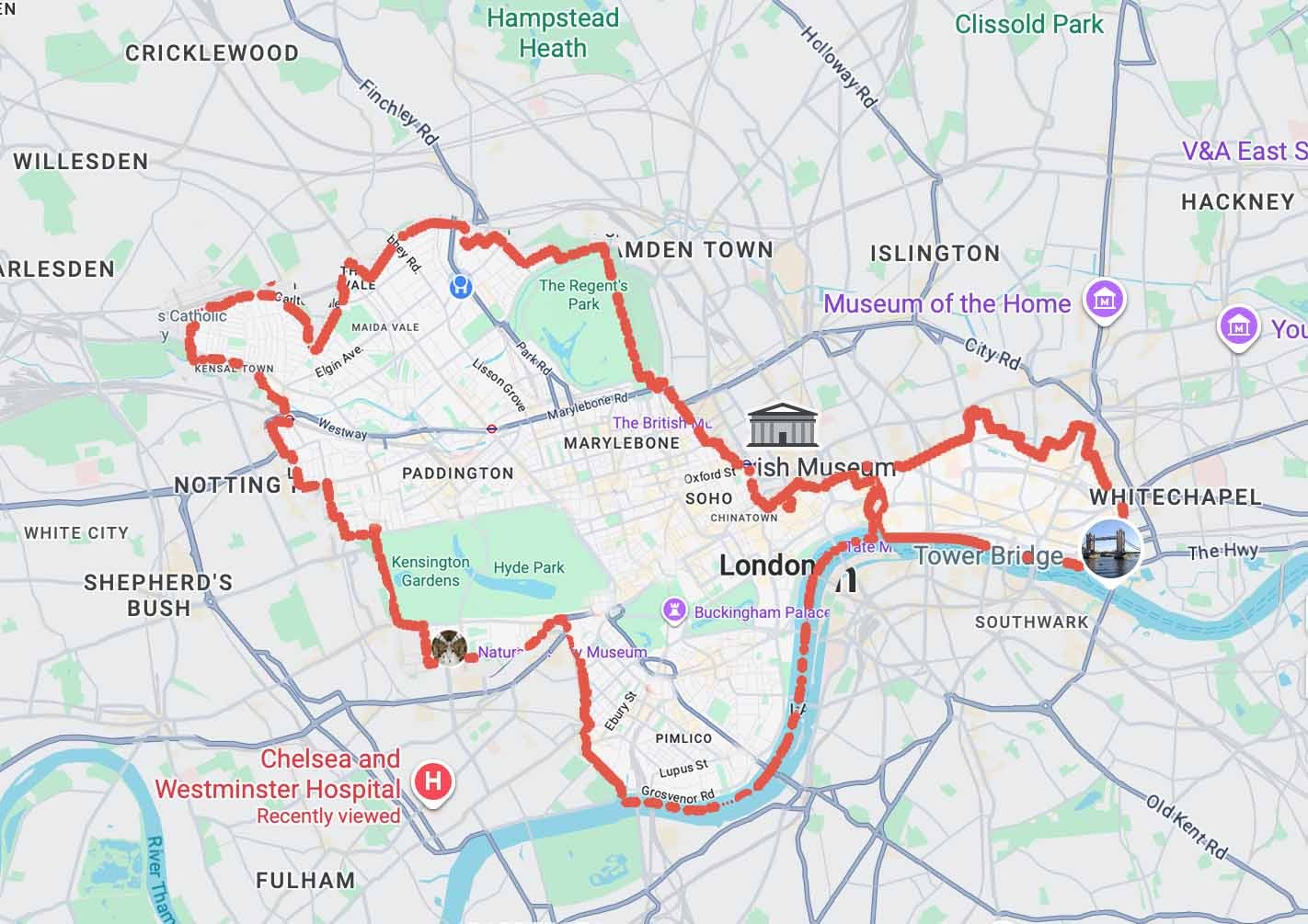
In this map, the bigger area on the left marks the boundary of the City Of Westminster and the smaller area to the right is the City Of London. And as you can see, they are adjacent to one another.
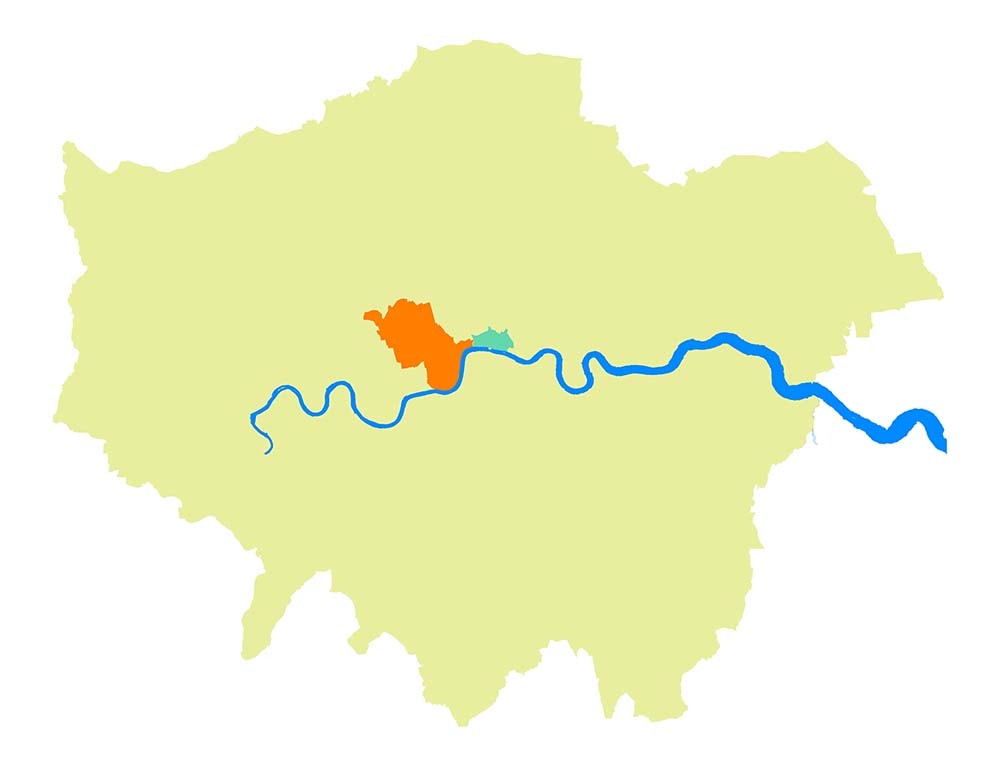
And here is a map of London with the two 'cities' marked on it - one orange and one green.
So how come they exist are all bearing in mind they are right in the middle of London.
They say you have to be English to understand why we have such weird pronunciations or why we have a city within city and in fact two adjacent cities within a city.
Looked at logically it makes no sense at all, but it makes more sense when you think about how the areas grew up historically and how once people are invested in something they don’t want to give it up.
Within Greater London there are two cities, the City of London and the City of Westminster, and they are adjacent to one another.
Perhaps the best way to explain how they came about is the often used description that London is a collection of villages. In the case of the City of Westminster and the City of London, they grew to become cities in their own right before the London we know today had grown and surrounded them and taken them into its fold.
The City of Westminster borders the north bank of the River Thames and stretches north as far as St John’s Wood and The Regent’s Park. It also covers Buckingham Palace, the Houses of Parliament, 10 Downing Street, and Westminster Abbey. And it is one of the 33 local government districts that make up Greater London.
It has been a city since 1540 and both it and the city of London are subject to UK parliamentary legislation and national governance. So they are not a law unto themselves at the national level.
The City of Westminster is governed by Westminster City Council, which is a local authority responsible for providing services and making decisions within its jurisdiction. So Westminster is a typical modern borough. Sure, it is called a city, but it obeys all the rules just like another borough.
The City of London is different.
The City Of London
The City of London Corporation governs the City of London. The Corporation was established in medieval times, but there is no record of a charter that incorporated it. Instead, the corporation is considered incorporated by prescription, meaning that the law assumes it was incorporated because it has been considered as such for so long.
In other words, we don't know when it started and we don't have evidence that it was created this way, but it has been there so long that we must assume that it did start that way.
This is a typically English solution.
The leader of the City of London is the Lord Mayor of London, which is a distinct and separate office from the Mayor of London who is the leader of the Greater London Authority.
More English confusion if you didn't know there are two mayors.
The police authority is the City of London Police, founded in 1839, one of the oldest police forces in the UK. It is separate from the Metropolitan Police Service and has jurisdiction in the Square Mile, as the financial district of London is known.
Beyond its general role as a police force, it focuses on fraud, cybercrime, and money laundering, and it is headquartered in Guildhall Yard East located within the City of London.
The Metropolitan Police, or to give its full title the Metropolitan Police service on the other hand has its headquarters at New Scotland Yard, at the Curtis Green Building on the Victoria Embankment in Westminster.
So two quite separate police forces rubbing shoulders with one another.
And did I mention that British Transport Police, which has its own jurisdiction over the land and buildings and locomotives of all kinds on British Transport land? Just one more jurisdiction that has resulted from the millennia-old origins of Britain.
Minsters
The word Minster comes from the Old English mynster, meaning a monastery or mother church. Mynster in turn comes from the Latin monasterium, which traces its roots back to the Ancient Greek monasterion which meant a place to live alone, separate from the world.
In England, minsters originated in seventh century Anglo-Saxon England as missionary teaching churches or churches attached to a monastery.
Historically, the main minsters in England began in the north, and stretch from Beverly Minster in East Yorkshire and down the eastern side of England.
And that brings us to Westminster, which describes the West Monastery established in the tenth century as an Anglo-Saxon church.
When it was re-endowed and enlarged in later centuries This church became known as the west minster to distinguish it from the east minster (St Paul's Cathedral) in the City of London.